
Cities are growing and so are their logistical headaches. With increased eCommerce demand, food delivery, and courier services, urban areas are facing a delivery crisis: traffic congestion, limited parking, environmental pressure, and rising customer expectations. Delivering in the city today is no longer just a logistics task, it's a complex problem that needs smarter, greener solutions.
That’s where Dropit steps in. Using a combination of EV cycles, route intelligence, and micro-fulfillment strategies, Dropit is solving the very challenges that plague city deliveries. In this blog, we’ll explore the common pain points in urban logistics and how Dropit is uniquely equipped to address them.
1. The Urban Delivery Dilemma
Urban areas are notoriously difficult for last-mile logistics. The most common issues include:
- Traffic congestion: Slows down vehicles, creates unpredictable delivery times
- Parking restrictions: No legal stopping zones in many downtown areas
- Narrow lanes and pedestrian zones: Inaccessible to vans or cars
- Environmental regulations: Low-emission zones and green mandates
- Customer pressure: Real-time tracking, tight delivery windows, and zero tolerance for delays
For conventional delivery fleets, navigating this environment is costly, slow, and inefficient.
2. Dropit’s Answer: Smart, Sustainable Urban Logistics
Dropit doesn’t just operate in cities, it was built for them.
The platform deploys:
- Electric cargo cycles for agility and zero emissions
- Hyperlocal route planning to reduce mileage and avoid choke points
- In-app delivery tracking for customers and real-time updates for drivers
- Integrated pickups from nearby stores instead of distant warehouses
Together, these systems form a city-ready delivery model that thrives where traditional logistics fails.
3. Solving Traffic Congestion with EV Cycles
Traffic is one of the biggest barriers to reliable city delivery. Dropit’s electric cargo cycles bypass traffic bottlenecks by:
- Using bike lanes and pedestrian-friendly routes
- Operating during peak congestion hours with minimal delays
- Navigating through high-density areas without relying on vehicle clearance
Because these bikes don’t rely on main roads or highways, they can deliver faster and more predictably during rush hour.
4. No Parking? No Problem.
Parking is a logistical nightmare in cities. Delivery vans often get fined, blocked, or forced to park far from the destination increasing delivery time and risk.
Dropit’s EV cycles:
- Require no dedicated parking zones
- Can stop at doorsteps, alleys, and loading bays
- Are lightweight and mobile, even on footpaths (where permitted)
This drastically cuts down wait time, ticket risk, and failed deliveries due to inaccessible addresses.
5. Micro-Fulfillment Hubs = Less Travel, More Efficiency
Instead of delivering from centralized hubs or warehouses, Dropit picks up directly from retail stores and dark stores within the city. This model:
- Shortens the delivery radius
- Cuts down fuel and energy usage
- Allows faster batching of multiple deliveries
- Reduces return-to-depot time
It’s local, fast, and designed to scale without expanding delivery zones.
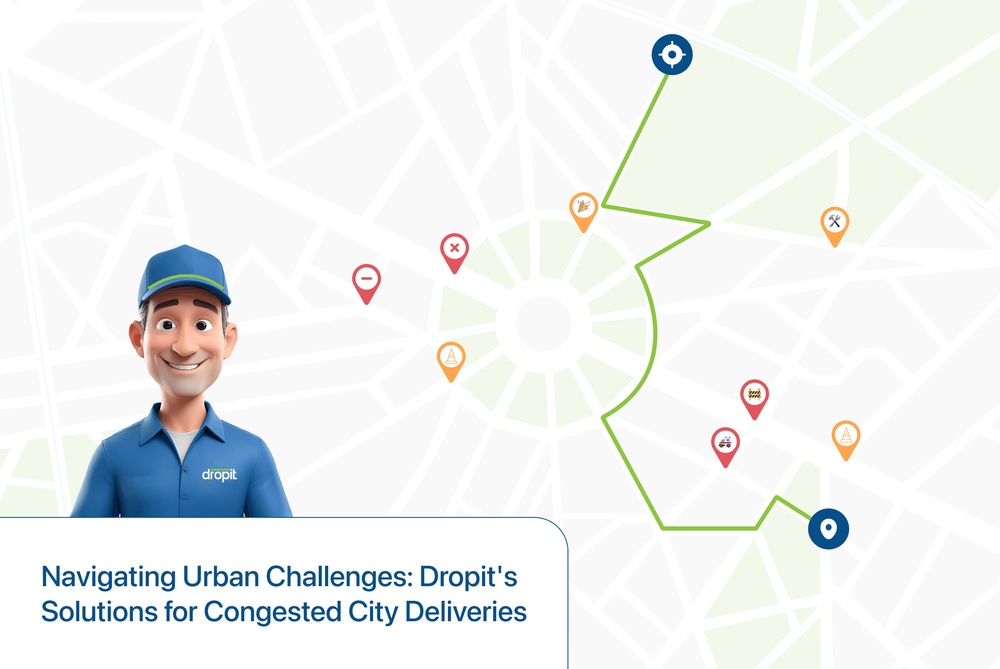
6. Predictive Route Optimization
Dropit’s AI-powered routing engine:
- Plans delivery routes based on real-time and historical traffic data
- Adjusts routes dynamically for road closures, weather, or congestion
- Prioritizes zones with high density of deliveries
- Minimizes time between stops
This ensures efficient routing even in unpredictable urban environments.
7. Low-Emission Zone Compliance
Many cities are introducing Low Emission Zones (LEZs) or Green Delivery Mandates. Dropit is future-ready:
- EV cycles emit zero carbon, ensuring full LEZ compliance
- Riders do not require special vehicle certifications
- Businesses using Dropit avoid environmental fines or permit issues
This makes Dropit the go-to partner for sustainable city delivery.
8. High-Frequency Deliveries in Dense Neighborhoods
Dropit enables multi-stop deliveries with high efficiency:
- Ideal for apartment blocks, office parks, and commercial clusters
- Batches 3–6 deliveries per rider with minimal backtracking
- Reduces cost per drop and increases speed
Unlike bulky delivery vans that may only complete a few drops per hour in the city, Dropit’s riders can complete 10–15 deliveries in the same timeframe.
9. Reduced Delivery Failures & Missed Windows
Because Dropit’s model is agile and localized, it drastically reduces:
- Delays due to gridlock
- Missed time slots
- Undelivered packages caused by inaccessible locations
Plus, with real-time customer tracking and communication, recipients know exactly when to expect the delivery increasing success rates.
10. Scalable Infrastructure for Expanding Cities
Cities will continue to grow and delivery needs will only get more complex. Dropit’s model is:
- Modular: Easily deployed in new zones
- Tech-enabled: Scales through software, not fleets
- Partner-friendly: Integrates with local retailers, malls, and logistics teams
- Cost-efficient: Minimal infrastructure and fleet investment
This positions Dropit as the ideal logistics layer for the future of urban commerce.
Conclusion: Solving City Delivery Requires Rethinking the Vehicle
The biggest problem in urban delivery isn’t volume but its design. Vans and trucks weren’t built for cities. EV cycles were.
Dropit proves that with the right planning, technology, and approach, deliveries can be fast, clean, and efficient even in the busiest urban environments.
Ready to simplify your city deliveries?
Partner with Dropit and build an urban delivery network that thrives in complexity not collapse under it.