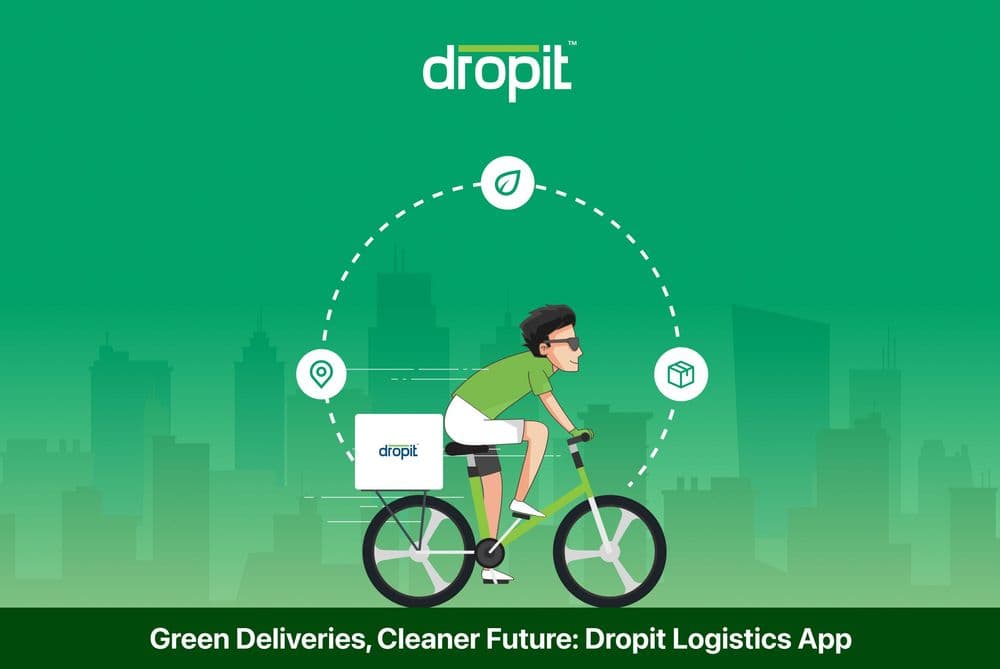
Green Deliveries, Cleaner Future: Dropit Logistics App
In an era where climate change, air quality, and resource consumption are under intense scrutiny, logistics and delivery systems carry a heavy responsibility. The last-mile delivery sector, in particular, contributes significantly to urban emissions and congestion. Yet, innovations and responsible approaches can turn this challenge into an opportunity. Dropit logistic app and service model is charting a path toward greener deliveries, cleaner cities, and a more sustainable future.
Rising Stakes in Urban Logistics
Cities across India and around the world are grappling with worsening air pollution, traffic gridlock, and the growing footprint of e-commerce demand. Every extra vehicle, every inefficient route, every idle kilometer adds to carbon emissions, particulate matter, and energy waste. As delivery volumes grow, inefficiencies compound, making it crucial for logistics platforms to rethink how they move goods.
Dropit recognizes this imperative. Rather than perpetuating old models, it is leveraging technology, new vehicle types, and operational design to reduce its environmental impact while still offering fast, reliable delivery.
Dropit’s Eco-Friendly Commitments
1. Green Vehicles & EV Cycles for Short Hauls
One of the standout features on Dropit’s homepage is the commitment to EV cycles / teenage earning programs. Dropit empowers young earners to handle short-distance deliveries using electric cycles, which are zero-emission and ideal for dense urban zones. The use of EV cycles means fewer fossil-fuel vehicles navigating narrow streets and delivering last-mile parcels.
By offering an eco-mode for small tasks, Dropit reduces its carbon footprint while engaging youth in sustainable earning opportunities.
2. Vehicle Variety & Flexibility
The Dropit delivery model is not one-size-fits-all. Users can select vehicle types appropriate to parcel size and urgency cycles, two-wheelers, three-wheelers, or trucks. This flexibility ensures that small parcels don’t get saddled onto large, inefficient vehicles which would waste energy and that bigger loads are still handled appropriately.
3. Optimized Routing & Multiple Jobs per Route
A core lever for emissions reduction is minimizing wasted travel. Dropit’s app enables multiple incoming jobs to be accepted in a given area, allowing drivers (Pilots) to group deliveries and avoid unnecessary back-and-forth trips. Rather than returning to base or making isolated runs, the platform dynamically optimizes routing so the vehicle carries the maximum load while minimizing travel distance.
4. Scheduling & Demand Management
Through scheduled pickups, users can set when a package is to be picked up, rather than forcing ad hoc requests that may cause erratic, inefficient dispatch patterns. By smoothing out demand peaks and enabling better planning, Dropit can allocate resources more efficiently, cluster pickups, and reduce empty-leg runs.
This scheduling also helps match supply and demand, meaning fewer “rush” journeys with partially loaded vehicles.
5. Transparency & Real-Time Tracking
While transparency is often seen through a customer-experience lens, it also supports sustainability. Dropit’s real-time tracking feature ensures clear visibility into routes, timings, and performance. For internal operations, this data helps monitor inefficiencies, detect deviations, and continually fine-tune routing algorithms.
Additionally, tracking enables accountability deliveries that go off-route or idle can be flagged for analysis, leading to continuous operational improvement.
How It All Adds Up: Emissions Gains & Urban Benefits
When you combine green vehicles, optimized routing, load consolidation, and scheduling discipline, the environmental benefits multiply. Some of the key outcomes include:
- Lower CO₂ and pollutant output per delivery especially in dense urban cores.
- Reduced traffic congestion thanks to fewer vehicles on the road and more efficient movement.
- Less noise pollution, especially in residential zones, with EV cycles and smaller vehicles.
- Energy savings through fewer wasted kilometers and avoidance of empty returns.
- Long-term scaling where incremental efficiency gains compound as the delivery network grows.
Dropit’s approach aligns with broader sustainable logistics trends, such as micro-distribution hubs, cargo bikes for last-mile legs, and data-driven route optimization. Even if Dropit is not (yet) disclosing exact emissions numbers publicly, its design philosophy is clearly built for lower-impact growth.
Challenges & Path Forward
Of course, ambitious sustainability goals come with real challenges:
- Vehicle infrastructure: Charging infrastructure must keep pace if more EVs are deployed.
- Scaling green modes: EV cycles are great for short distances, but scaling them for heavier loads or further distances requires thoughtful deployment.
- Data & algorithm sophistication: Efficient routing under dynamic city conditions (traffic, road closures, peak hours) demands advanced predictive models.
- Behavioral change: Encouraging users to prefer green options (e.g. EV mode) when perhaps cost or speed is slightly different.
- Measuring impact: Public reporting of carbon savings, emission reductions, and efficiency metrics helps build trust and accountability.
Yet Dropit seems well-positioned to grow this further. Its core app features (multiple jobs, scheduling, real-time tracking) provide the backbone for continual optimization. As the network and technology mature, deeper AI-driven routing, predictive demand planning, and fleet electrification can push performance further.
Why Dropit Logistics App Stands Out in Green Logistics
Among the emerging logistics apps in India, Dropit offers a compelling value proposition:
- It integrates eco-friendly modes (EV cycles) directly in its core offering.
- It gives users and business clients control over vehicle choice, promoting more efficient usage.
- Its routing and job clustering reduce unnecessary kilometers, a cornerstone of lower-emissions logistics.
- Its transparency and tracking capabilities support accountability and ongoing improvement.
- It also addresses social inclusion through teenage earning via green transport, aligning environmental and societal goals.
Conclusion
As cities grow and delivery demands surge, the risk is clear: more vehicles, more emissions, more congestion. But Dropit is charting a different path. Through smart vehicle selection, EV cycles, route optimization, multiple-job dispatching, and scheduled logistics, the Dropit logistics app offers a model where convenience and speed need not come at the planet’s expense. By embedding sustainability into its core operations, Dropit is helping shape a cleaner, greener future for urban logistics.